Sales training is a one-off event that teaches your team a method, builds their knowledge and introduces new skills. Sales coaching is an ongoing, individualised process that embeds those skills into behaviour through regular reinforcement, practice and feedback. Most sales development programmes fail in the gap between the two: the team learns the method in training, but without coaching, they revert to old habits when the pressure is on.
Both are necessary. Training alone rarely produces sustained behaviour change. Coaching without training lacks a shared framework and method. The question is not which one to choose, but how to combine them so your sales team actually changes how they sell.
What is sales training, and when does it work?
Sales training is an event. It might be a two-day workshop, a certification programme, a series of modules delivered over a few weeks. The purpose is to teach a sales methodology, build product knowledge, introduce new skills or frameworks, and align the team around a common approach.
Good sales training gives your team the tools they need. At Unlimited People Consulting (UPC), we deliver sales training based on proven methodologies like SPIN Selling, which is grounded in research into more than 40,000 sales calls over 40 years, in more than 20 countries (Huthwaite International). SPIN teaches a questioning framework: Situation, Problem, Implication, Need-payoff. It is behaviour-based, research-backed, and learnable.
Training works when the team needs a shared method, when new hires need to get up to speed, or when you are rolling out a new sales approach across the organisation. It gives everyone the same language, the same tools, the same understanding of what good selling looks like.
But training alone does not change behaviour. Knowledge is not the same as skill, and skill under controlled conditions is not the same as performance under pressure. That is where coaching comes in.
What is sales coaching, and why does it matter alongside training?
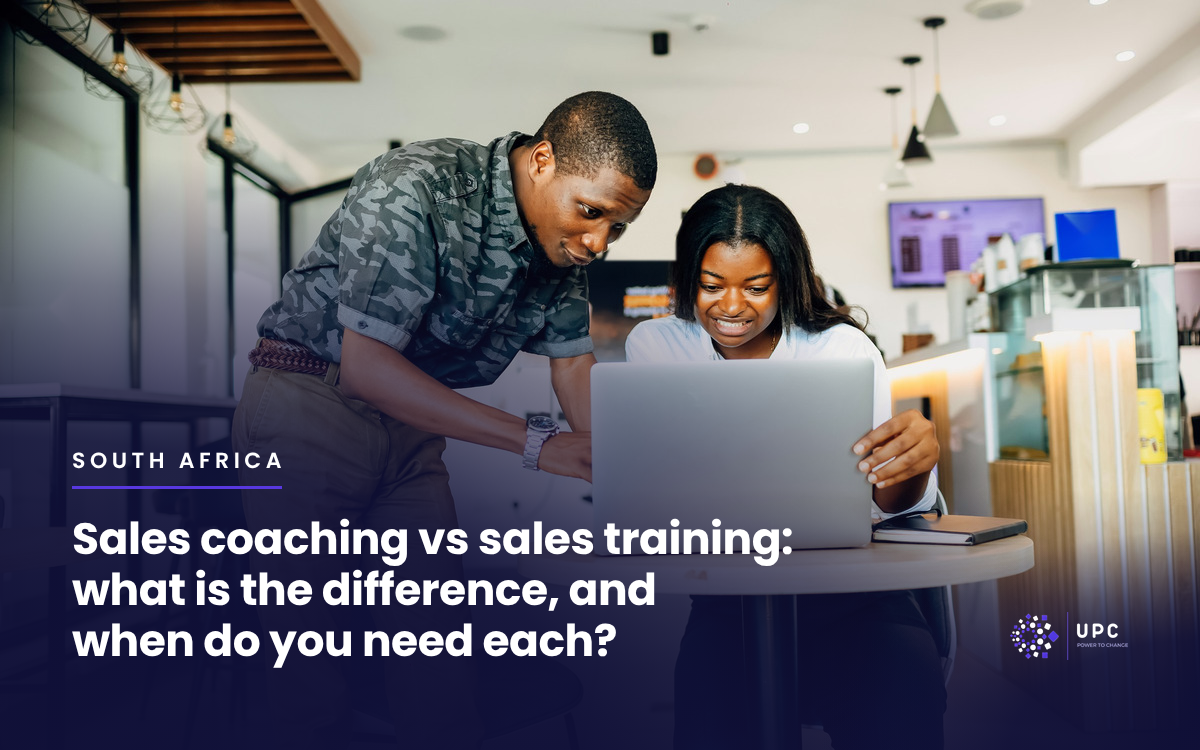
Sales coaching is an ongoing process. It is regular, individualised sessions with a coach, for example, weekly or monthly, where a salesperson works on embedding the behaviours they learned in training. The coach listens to real sales calls, observes live interactions, reviews deals in the pipeline, and helps the salesperson troubleshoot challenges as they arise.
Coaching turns knowledge into habit. A salesperson might understand the SPIN framework intellectually after training, but applying it in a high-stakes client meeting, under time pressure, with an unpredictable buyer, is entirely different. Coaching helps them practise the behaviours in real situations, get feedback, adjust, and try again until the new approach becomes second nature.
At UPC, we see this pattern consistently. Sales teams attend training, learn the method, try it once or twice, then slide back to their old habits. Why? Because changing behaviour takes time, repetition and individualised reinforcement. Coaching provides all three.
We have written about why sales training often fails to change behaviour. The gap between knowing and doing is one of the biggest reasons. Coaching closes that gap.
How are sales training and sales coaching different in practice?
Training is about the group; coaching is about the individual. Training delivers a method to everyone at once in a classroom setting, often with role-plays and simulated scenarios. Coaching tailors that method to each person’s strengths and real sales situations in one-on-one sessions focused on actual deals and live pipeline challenges. Training is time-bound (you attend the course and it is done); coaching is continuous, running for months to reinforce behaviours until they stick. Training measures knowledge retention; coaching measures behaviour change in real client conversations.
When do you need sales training?
You need sales training when your team lacks a shared methodology, when you are onboarding new salespeople, or when you want to introduce a new approach across the sales function.
If your sales team is using different methods, asking different types of questions, and approaching deals inconsistently, training aligns them. It gives everyone the same playbook and the same language.
If you have new hires who need to learn how to sell in your market, how to handle objections, how to qualify opportunities, training gets them up to speed faster than trial and error.
If your sales environment has changed (new competitors, new buyer behaviours, commoditisation pressure, longer sales cycles), training introduces a methodology suited to the new reality. For example, SPIN Selling was designed specifically for complex, high-value business-to-business (B2B) sales, where the buyer’s decision process is long, multiple stakeholders are involved, and the salesperson needs to uncover needs the buyer may not have articulated yet.
Training is the foundation. But it is not the finish line.
When do you need sales coaching?
You need sales coaching when you want the training to stick. Always.
More specifically, you need coaching when your salespeople know the method but are not applying it consistently, when they are stuck on specific deals and need help unsticking them, when performance is uneven across the team, or when individual reps have behavioural gaps that group training cannot address.
Coaching is where the real performance improvement happens. In our experience, and across the sales development field, coaching is what turns a training course into lasting behaviour. A salesperson who receives regular coaching performs better than a salesperson who only attended training.
At UPC, we offer coaching as an essential follow-on to training. We run individual sessions, for example weekly or monthly, depending on what the client needs. We coach on live deals: how to explore an opportunity using SPIN questions, how to handle a stalled deal (we have written about why B2B deals stall and how to unstick them), and how to negotiate when the buyer is pressing hard on price.
Group coaching also has value. Team coaching sessions allow salespeople to learn from each other’s challenges, share wins, troubleshoot difficult accounts collectively, and hold each other accountable. But individual coaching is where the deepest behaviour change happens, because it is tailored to the specific rep, the specific deal, the specific challenge.
What does UPC offer South African sales teams?
UPC is the exclusive Authorised Provider of Huthwaite International programmes in Sub-Saharan Africa. We deliver sales training based on SPIN Selling, SPIN Coaching, SPIN Sales Opportunity Management, and other research-backed Huthwaite methodologies. These are not generic sales courses. They are behaviour-based programmes designed for complex B2B sales, backed by decades of research.
We also deliver ongoing sales coaching to embed those behaviours. Training teaches the method. Coaching makes it stick. Most of our clients combine both: a training programme to build the foundation, then months of coaching to turn knowledge into performance.
Our services include sales performance and strategy programmes, individual and group coaching, and a free tool, the Sales Team Behaviour Map, to help you understand where your team is now and where they need to go.
If your sales team has been through training before and nothing changed, the missing piece was probably coaching. If your team is struggling to apply what they learned, or if performance across the team is inconsistent, coaching is the answer.
FAQ: Sales coaching and sales training
How long should sales coaching last?
Sales coaching should continue until the new behaviours are embedded and performance has improved. In our experience, lasting behaviour change requires months of regular sessions, not just one or two coaching sessions.
Can we do sales coaching without sales training first?
You can, but it is less effective. Coaching works best when the team has a shared methodology and language. If everyone is using different approaches, the coach has to start from scratch with each person. Training creates the common foundation. Coaching builds on it.
What is the difference between sales coaching and sales management?
Sales management focuses on pipeline reviews, forecasting, deal strategy, and hitting targets. Sales coaching focuses on behaviour change: helping the rep improve the skills and habits that drive performance. Both are necessary, but they are not the same thing.
How do we measure whether sales coaching is working?
Measure behaviour change and results. Are reps asking better questions in client meetings? Are they qualifying opportunities more rigorously? Are win rates improving? Is average deal size increasing? Are sales cycles shortening? Those are the signals that coaching is working.
Do we need external sales coaches, or can our managers do it?
Managers can coach if they have the time, the skills, and the discipline to do it consistently. Many find it challenging to balance coaching with other responsibilities. External coaches bring expertise, objectivity, and dedicated focus. They are not distracted by pipeline reviews, administrative tasks, or internal politics. They are there to develop the rep. UPC also equips managers to coach their teams through programmes like SPIN Coaching.
What sales methodologies does UPC coach on?
We specialise in SPIN Selling and other Huthwaite programmes, because they are research-backed, behaviour-based, and proven in complex B2B sales. We also coach on sales negotiation, opportunity management, and deal qualification. All our coaching is grounded in real methodology, not generic advice.